Space Charge
Space-charge is the charge density that exists in free space, such as inside a particle beam. It is in contrast to, for example, charge density on conductive electrode surfaces or the bound charges within insulative materials. Space-charge is important to consider because charge density, in any form, affects electric fields via Coulomb’s Law (or, equivalently, the Poisson Equation), which in turn also affects the trajectories of charged particle beams (by the Lorentz Force Law).
Often, space-charge is small or negligible, in which case we can calculate the electric field ignoring space-charge and then calculate particle trajectories in that previously calculated field. This is the typical SIMION usage where you Refine (solve the Laplace Equation) and then Fly’m (solve the Lorentz Force Law). However, at higher beam currents, space-charge must be taken into account. This adds additional complexity because the electric field and particle trajectories must be solved simultaneously because they are mutually coupled: The electrode surface charges and space charges both alter the electric field in space, which in turn alter each others’ distribution in space (since both electrode surface charges and space-charge are free to move and experience forces from the field), which in turn circularly affect the electric field, ad infinitum. Any time-dependency in either charge distribution requires additional consideration, though often we are concerned with only steady-state behavior.
In typical operation, SIMION ignores space-charge to keep things simple, but SIMION has two methods for space-charge handling if you need it.
First, SIMION since at least as far back as 7.0 has supported a couple Charge Repulsion methods. When enabled, this accounts for Coulomb’s Law-like “particle-particle” forces (with ion-cloud correction) to simulate repulsion between all the beam particles or beam lines. It does not, however, account for forces between the particles and the electrode surface charges, which would instead require the Poisson Equation. These “charge repulsion” methods are generally used to “estimate the onset of space-charge.” See p. 2-6 of the SIMION 8.0/8.1 manual (2-5 of the SIMION 7.0 manual) and p. 8-17 (“The Charge Repulsion Controls”). Details of the calculation methods are in the “Computational Methods” appendix and (discussion). There is a further discussion of SIMION’s charge-repulsion methods in the 2005 Appelhans and Dahl paper. Some of the SIMION examples use this, or at least suggest its use in their README files, including SIMION Example: einzel, SIMION Example: drag, and SIMION Example: trap. Moreover, the SIMION Example: repulsion (added in 8.0.4) contain a much more thorough discussion and analysis (README and examples) of the use and reliability of these repulsion methods.
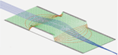
Second, SIMION 8.1 has a true Poisson solver (see Poisson Solver in SIMION ). Iterative methods can be implemented in user code, and some examples have been developed (SIMION Example: poisson). Be sure to update to version 8.1.0.40 or above because the examples were significantly extended in this version. There are various ways to apply the Poisson solver, but it’s fully programmable, and methods of applying it will likely be expanded more in the future. Generally speaking, use of the Poisson solver in cases involving particle trajectories (not all uses of the Poisson solver involve particle trajectories) can involve an iterative method of solving where the potentials/fields in space and the particle trajectories are recalculated alternately until convergence. It requires some experience to use effectively and such uses may still be somewhat experimental.
One advantage of repulsion methods is that, although it is an approximation, it is fairly efficient and simple (though still you should be careful). The Poisson approach, however, is generally more complete but requires more set-up, thought, and care. Much of this is inherent.
See Also
Space Charge in Mass Spectrometry (K.L. Busch, Spectroscopy, June 2004)